
What Is Bandwidth & What Does Unmetered Bandwidth Really Mean?
 Olivia H.3 min read
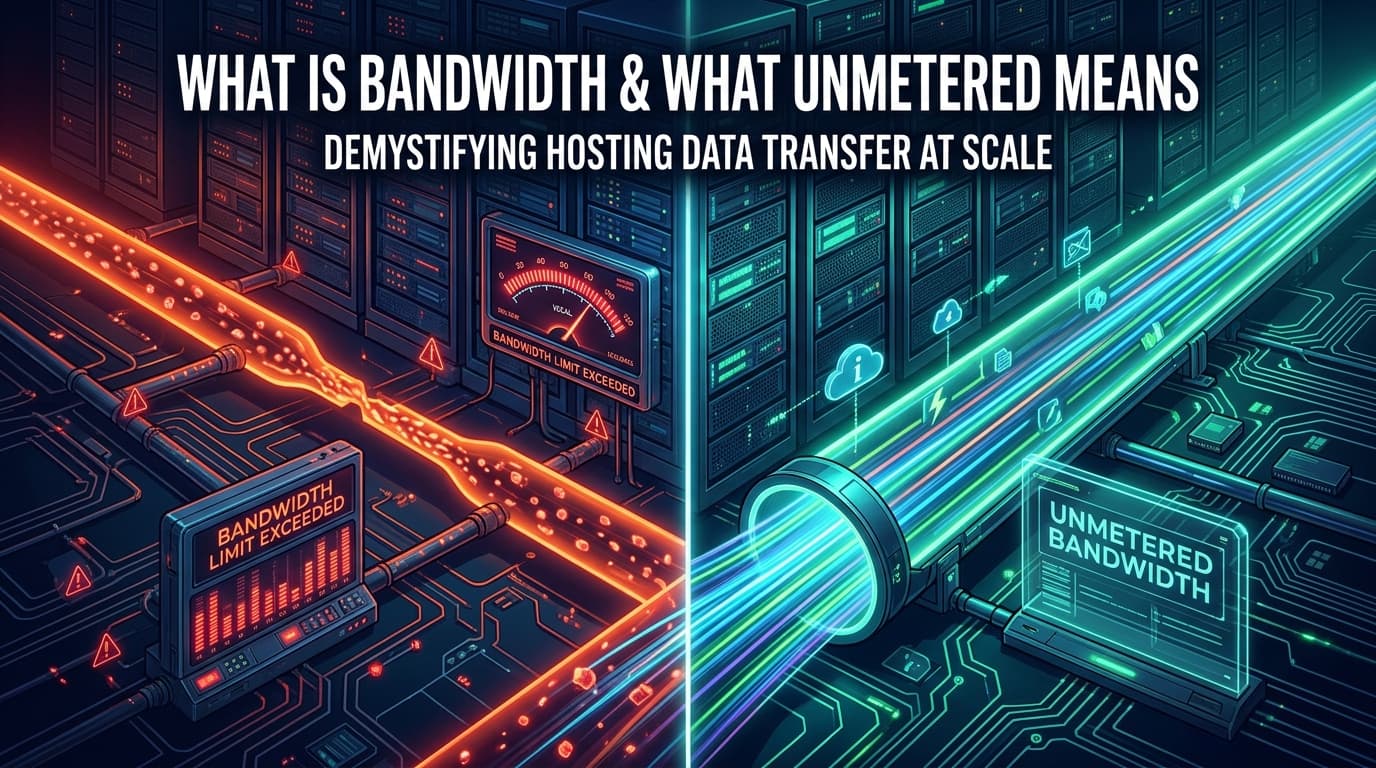
When choosing a web host or scaling a growing WordPress website, hosting specifications often list terms like "Bandwidth," "Data Transfer," and "Unmetered Bandwidth."
While these terms are frequently used interchangeably by hosting marketing teams, they refer to distinct networking concepts. Misunderstanding how network capacity works can lead to unexpected overage fees, site throttle warnings, or downtime during traffic spikes.
Let’s demystify what bandwidth actually means, clarify the difference between unmetered and unlimited, and explore how infrastructure design impacts data flow at scale.
1. Bandwidth vs. Data Transfer: Understanding the Highway Analogy
To understand hosting limits, it helps to distinguish between network capacity and total data consumed.
+--------------------------------------------------------------------+
|                   BANDWIDTH VS. DATA TRANSFER                      |
+--------------------------------------------------------------------+
|  Bandwidth (Width)       --> Maximum volume of data that can pass  |
|                              through the connection per second.    |
|                              (e.g., 1 Gbps port link speed).       |
|                                                                    |
|  Data Transfer (Volume)  --> Total cumulative gigabytes/terabytes  |
|                              moved over a billing cycle.           |
|                              (e.g., 500 GB bandwidth allowance).   |
+--------------------------------------------------------------------+
- Bandwidth: Think of bandwidth as the number of lanes on a highway. A 1 Gbps (Gigabit per second) network port allows a large amount of traffic to flow simultaneously without creating a gridlock bottleneck.
- Data Transfer: Think of data transfer as the total number of cars that passed through the toll booth over an entire month.
Every time a visitor loads your homepage, views an image, or downloads a PDF, data is transferred from your server to their browser. If your homepage is 2 MB in size and receives 10,000 visitors, your server has transferred 20 GB of data.
2. "Unmetered" vs. "Unlimited" Bandwidth: What’s the Catch?
Many hosting providers advertise "Unlimited Bandwidth," leading site owners to assume they can handle viral traffic surges without constraints. However, physics and server hardware impose real physical limits.
A. The Truth About "Unlimited" Bandwidth
In physical infrastructure, there is no such thing as truly unlimited data transfer. Network hardware, transit providers, and data center fiber interconnects all incur real costs.
When low-cost shared hosts promise "Unlimited Bandwidth," it is almost always bound by an Acceptable Use Policy (AUP). If your site consumes excessive CPU, RAM, or network port capacity, the host will quietly throttle your site speed or force an upgrade.
B. How "Unmetered" Bandwidth Works
Unlike "unlimited," Unmetered Bandwidth is an honest engineering spec.
When a host provides Unmetered Bandwidth:
- You are assigned a fixed network port speed (e.g., 1 Gbps or 10 Gbps pipeline).
- The host does not count or bill you per gigabyte of data transferred through that port.
- You can utilize 100% of that port speed continuously without incurring unexpected overage charges or artificial monthly transfer caps.
3. Why Caching & Edge CDNs Drastically Reduce Bandwidth Needs
High-traffic websites don't just need larger network pipes-they need smarter data delivery strategies.
By pairing server-level caching with global Edge WAF networks like Cloudflare, up to 80%–90% of static requests (images, CSS, JS) are served directly from edge nodes near the user. This preserves your origin server's network capacity for dynamic database queries and PHP execution.
High-Performance Network Infrastructure with OneStopWP
At OneStopWP, we take the mystery out of hosting specifications. Built on modern architecture and powered by enterprise network backbones, our managed hosting offers:
- Transparent Unmetered Port Speeds: High-capacity network connectivity designed to handle severe traffic spikes effortlessly.
- Edge CDN Integration: Integrated Cloudflare edge delivery to cache static media close to your visitors.
- In-House WPCacheOn Optimization: Our proprietary WPCacheOn plugin (available on WordPress.org) significantly compresses payload sizes and offloads server transfer requirements.
👉 Ready for transparent, high-speed managed WordPress hosting? Explore OneStopWP plans today.
See our plans and grab your discount while promotions last.
See plansKeep reading
All posts → WordPress Hosting & OptimizationOneStopWP Optimizer: Free Security Checks and One-Click Fixes for Every OneStopWP Hosted SiteDenny G.Date: Nov 9, 2026
 WordPress Hosting & OptimizationCritical PHP Vulnerabilities (CVE-2026-109618 & CVE-2026-109619): Our Proactive Security ResponseOlivia H.Date: Oct 21, 2026
 WordPress Hosting & OptimizationThe Anatomy of WordPress Database Bloat: How to Keep MySQL Fast at ScaleOlivia H.Date: Jul 6, 2026
Stay up to date
Get WordPress hosting tips, product updates and resources straight to your inbox.